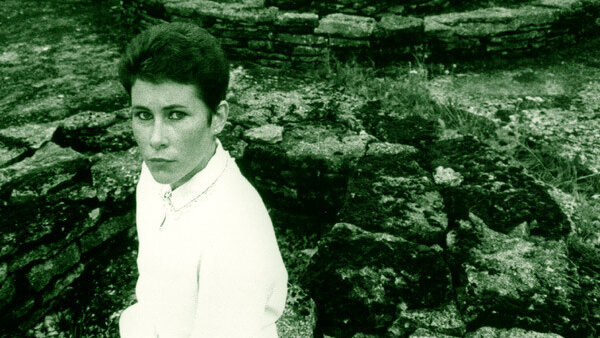
While Johanson and Sibul were household names, the same cannot be said about Kirile Loo. However, all three were ground-breaking innovators, originals, and talented. They left indelible marks on Estonian music.
Kirile Loo was born in 1960 in Kiviõli as Heidi Kruuse and received her musical education at the famed Georg Ots School of Music as a pop-jazz singer between 1983 and 1988. When she developed an interest in archaic Estonian folk songs, beyond the regilaul, she changed her name to better reflect her ethnic Estonian roots. Heidi Kruuse, after all, is also a fine German name.
She married folklore to our times, coming to my attention with the release of her 1994 CD Saatus (“Fate”). These lines are written in English rather than Estonian as the Erdenklang recording was most definitely aimed at the international audience. The booklet with the CD is written in Estonian, German, and English; the titles of the Estonian songs are translated to English.
A brief synopsis of the English liner notes, written by Ingrid Rüütel, Igor Tõnurist, and Peeter Vähi, translated by David Jessup: The majority of the singer’s childhood was spent at her grandmother’s home at Alutaguse. A magical place on the shores of Lake Peipsi covered by primeval forests and in many places untouched by civilization. There was no electricity in her grandmother’s home, fostering close ties with nature. Her grandmother was a folk singer and a major influence. The skills learned at her knee were important, as they could not have been obtained in any musical academy.
Peeter Vähi dodged the sentence of sixty-year-olds, turning seventy in May of this year. He is also an iconoclast as a composer and musician, an orientalist marrying eastern musical traditions with Estonian ones. His often-mystical recordings are highly recommended. The choice of Vähi as producer was a stroke of genius. Loo’s singing is simple, the supporting instrumental accompaniment unadorned. Tuule Kann is perhaps Estonia’s best psalterist (kanneldaja). Tõnurist plays the parmupill (Jew’s harp), Margus Rahuoja is on bagpipes, Peter Finger contributes guitar work and Vähi, while focusing on keyboards, also strikes the lokk (wooden gong) and provides backing vocals.
The sixteen cuts on Saatus are all traditional, ranging from a song about Creation to lullabies, skirls, and a mournful surnuitk, a dirge in the Võru dialect. A most wondrous introduction to the ancient Estonian tradition of expression of emotion through song, this CD was often on my evening playlist for years.
Emphasizing the target audience, the recording had success on the World Music Chart, peaking at number five. This led to tours abroad including concerts in Japan and Canada.
1999 saw the release of Lullabies for Husbands, also on the Erdenklang label. This recording was produced by Tiit Kikas and Ulrich Rützel. Kikas plays all instruments, beyond the traditional ones, adding modern ones such as electric violin, sampler, and synthesizer. Emphasizing the target audience, the recording had success on the World Music Chart, peaking at number five. This led to tours abroad including concerts in Japan and Canada. Alas, as a husband with a young family I was not aware of the local concert at the time. Shame, as it would have been quite an experience.
After reading about Kirile Loo’s passing I reacquainted myself with these two wonderful discs, which are irreplaceable in my collection. They were hard to source when they were marketed but worth the effort.
The Saatus liner notes perfectly sum up the recording. Allow me to quote the entire final paragraph.
“The artistic creed of Kirile Loo cannot easily be put into words. Her songs often convey a dual perception of the world, with a male and female polarity, and the contact between these two worlds—both sexual or spiritual. From a human perspective, the ideals of Kirile Loo are rooted in ancient times, when primitive man expressed thoughts in a straightforward manner, without unnecessary philosophical speculations.”
Quite a few selections from the two CDs can be heard on Spotify and other sites. I encourage starting with “Vana kannel”, which is also the first cut on Saatus, thus the same experience as for the CD listener. Kirile Loo sang “teeme õhtulla iluda, päiva mennessa menuda” (“let’s make merry in the evening, as the day fades away.”)
The merriment has passed along with the singer but the memories remain.