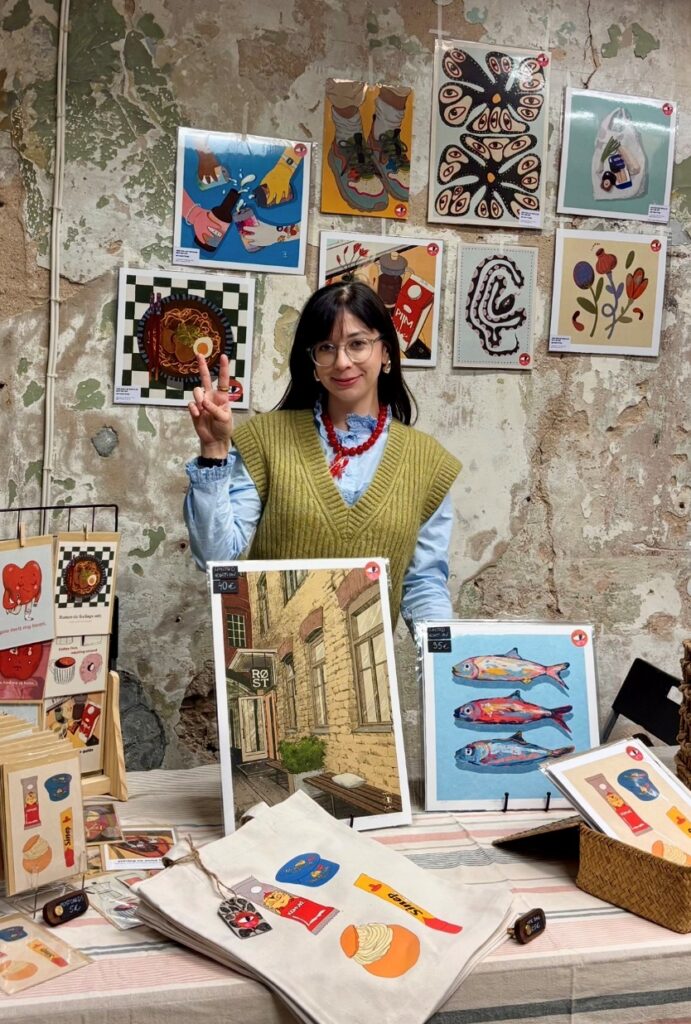
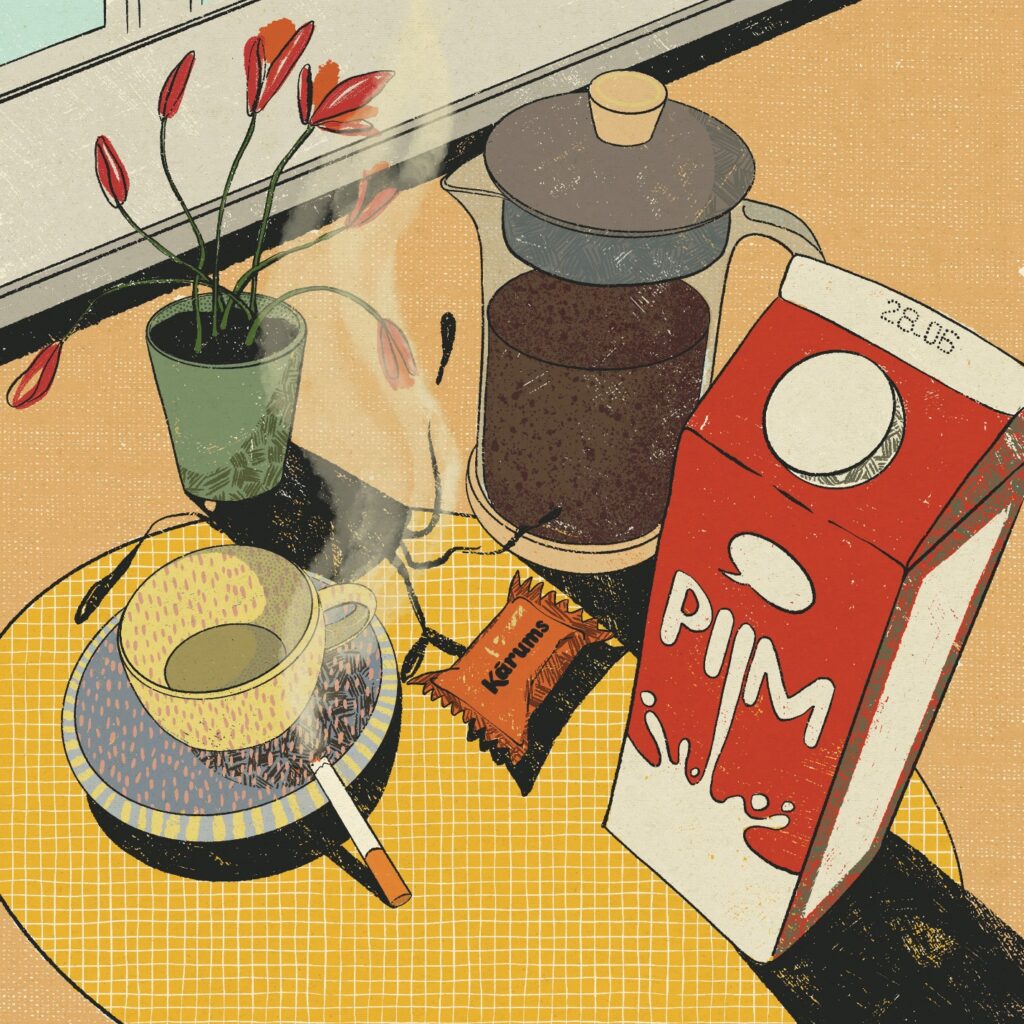
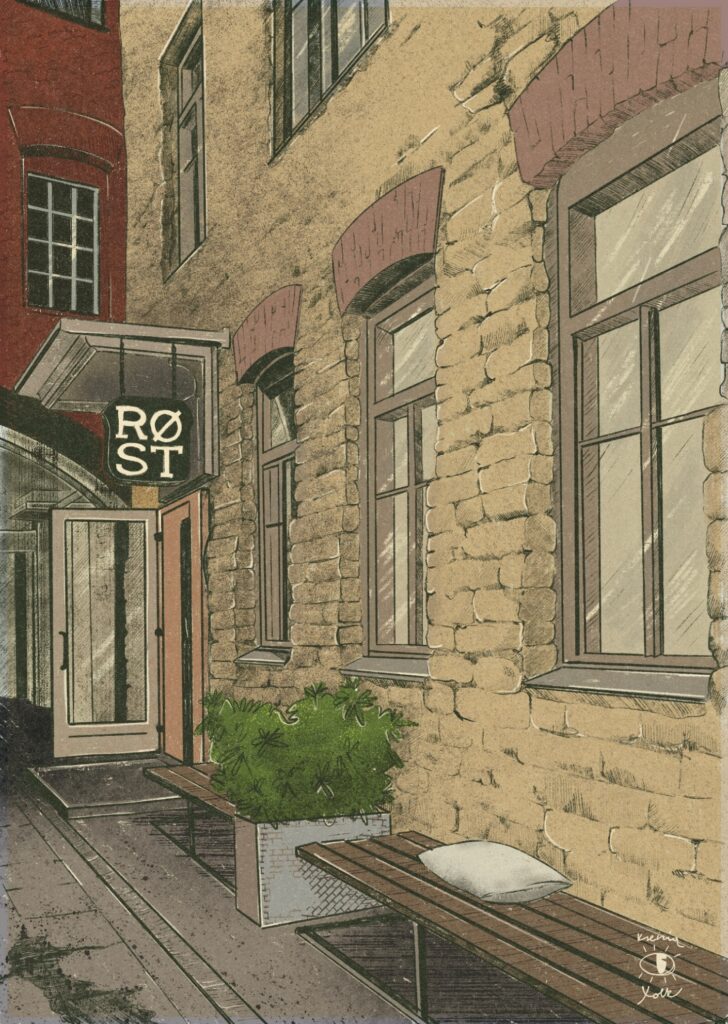
I first came across Ksenia Yolk’s work at the Telliskivi Ceramics Market in Tallinn, where she was selling her prints alongside other local artists. What caught my attention was a sense of coziness in her prints: food, coffee cups, tableware and packaging. These were ordinary objects that seemed to carry traces of both a home kitchen and a familiar café. I was struck by the affection with which these seemingly unremarkable, everyday things were portrayed. Small local details—like the word “piim” on a milk carton or a recognizable bakery in the Rotermann Quarter also give many of these scenes an unmistakably Estonian (and often specifically Tallinn) flavour.
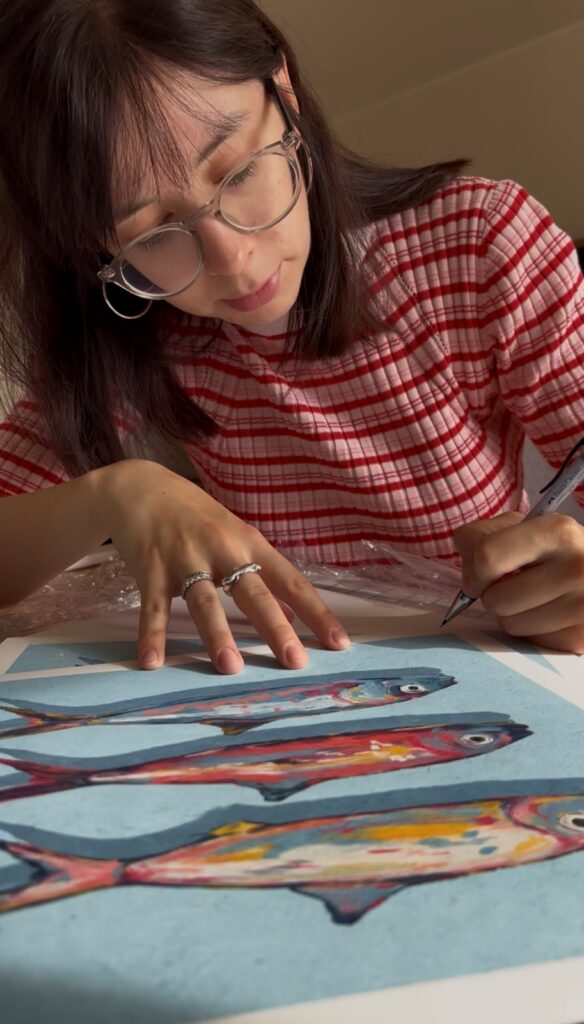
Curious about what inspires these subjects and this distinctive visual style, I asked Ksenia to tell me more about her work. She agreed to a short interview. Painting and drawing, she told me, have been part of her life since childhood: she grew up in a creative family and her father is an artist and sculptor. Yet, Yolk only began working actively as an artist about a year ago, after the birth of her child, when she went on maternity leave. “That period turned out to be incredibly difficult and transformative,”she says. “It had a profound effect on me and made me rethink a great many things about the way I live my life.”
Yolk draws inspiration primarily from contemporary women artists, including Livia Falcaru, Eniko Eget, and Üla Šveikauskaitė. Their use of colour, style, and subject matter has influenced her, although she does not consciously model her own work on theirs. She describes her own work as digital illustration with “touches of romanticism and melancholy,” moving between observations of everyday life and her inner world. The artist has no fixed way of beginning a new work: an idea may first appear on paper or digitally, depending simply on what is at hand. “If I'm not at home and don't have my iPad with me, I'll sketch in my paper sketchbook, which I always carry in my bag,” Ksenia says. “Or the opposite: I might want to create something on paper, but paper isn’t at hand, while my iPad is, so I sketch digitally.”
Yolk creates the grainy, textured surfaces of her illustrations in the app called Procreate, using different textures and brushes, techniques the artist learned through online tutorials and experimentation. Her subjects often arise spontaneously. A particular colour palette may catch her attention, or an arrangement of objects on a table may suddenly suggest a composition. At other times, an internal or external conflict finds its way into a new piece. The recurring imagery of food, drink, and kitchen life also reflects Yolk’s current surroundings and daily routine. “Since I'm a mother on maternity leave who spends a lot of time in the kitchen, it gives me the chance to look at very ordinary, everyday objects and things we use at home without ever really thinking about them, and to see them in a new light,” she says.
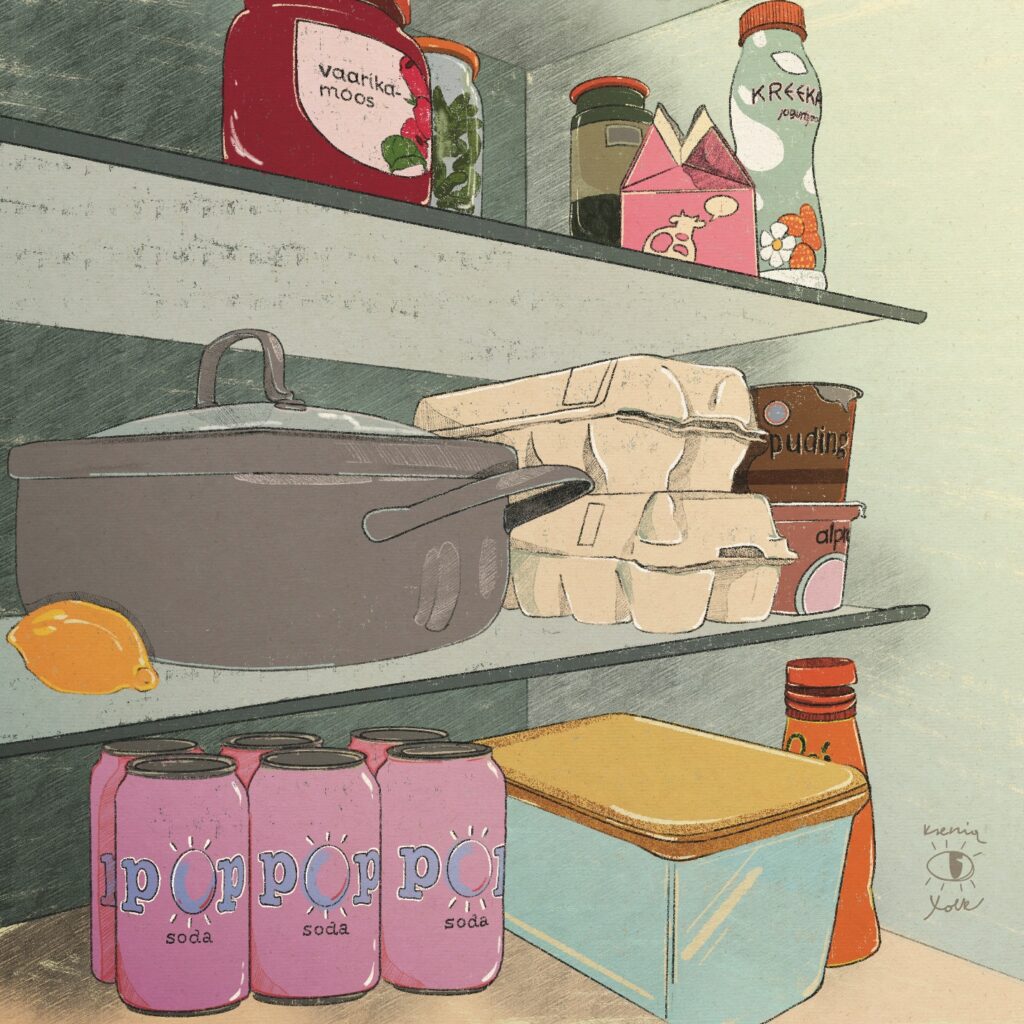
Although Yolk loves Tallinn, she does not consciously set out to capture the city’s character in all of her work. Still, she believes that an artist’s surroundings can exert a strong influence, sometimes at a subconscious level. What she does consciously seek is something unusual—or, conversely, something intimately familiar—within everyday experience.“I try to share that feeling of coziness and home,” the artist says of the everyday things she depicts. “I think these things genuinely evoke a sense of warmth and belonging.”
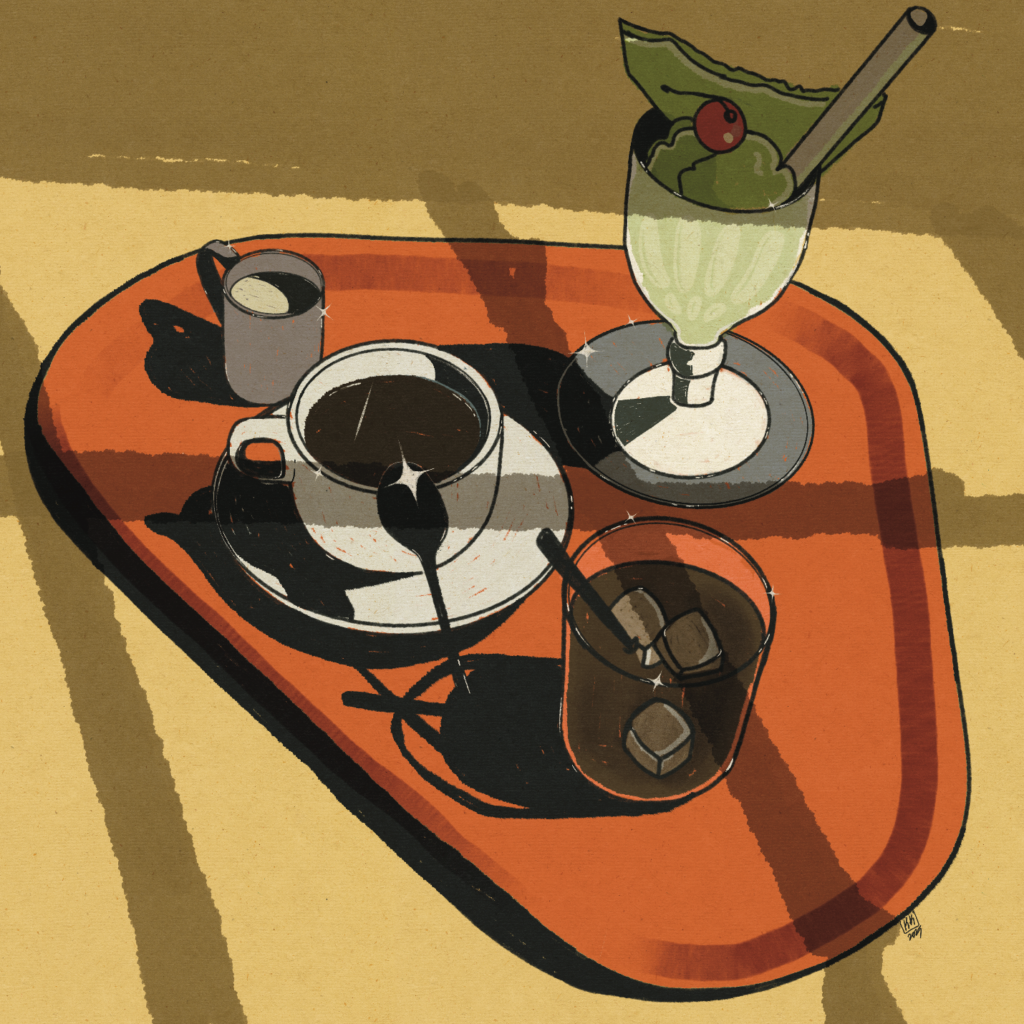
For Ksenia, pursuing an artistic career means balancing creative work with everyday responsibilities and practical challenges. Parenthood has changed her working routine more than her artistic outlook: having a child taught the artist to plan her time more carefully and structure her days more efficiently, allowing more time for drawing. Yolk adds that everyday life now carries greater anxiety because of the responsibility for another person. As for the practical challenges, Ksenia points out that making a living as an artist in Estonia can be financially precarious: freelance projects and commissions take time, income is irregular, and artists often have to look for clients abroad — problems compounded by the current economic crisis and declining purchasing power. “Commissioning illustrations is exactly the kind of expense that gets cut first,” the artist says. Her main income currently comes from participating in fairs and orders placed online, alongside commissions from local companies for the design of their websites, products and workspaces.
Ksenia exhibited her work in England while living and studying there, as well as in Tallinn some years ago. More recently, however, she has focused on working directly with private clients and companies, noting that exhibitions and publications can themselves involve considerable expense for an artist. Looking ahead, Yolk would particularly like to work with regular clients developing distinctive design for packaging of their products. “There’s something exciting about seeing your illustration take on a physical form and help highlight and sell a product,” she says, “whether it’s beer, a box of chocolates, or a bottle of wine.”