Estonia had achieved independence in 1918, but by 1940 after the signing by Germany and Russia of the Molotov-Ribbentrop pact, Estonia was placed into the Russian sphere of influence. Using this as an excuse, the Russians chose to occupy the country in 1940 and in the process, began to arrest, deport and execute thousands of Estonians, many in various high-ranking government and military positions.
In late 1940, my father, Rudolf Orav, had been detained and placed on a prison ship bound for Leningrad (now St Petersburg) Russia. Thanks to some stormy weather, the ship ran aground and most on board were able to escape.
In 1941, Hitler chose to ignore the previously mentioned pact and began his campaign to conquer Russia. The Baltic states, including Estonia, were occupied and the Russian forces were driven out. While the German occupation was also related to significant ethnic cleansing, with the detainment and execution of many Estonian Jews, Estonian Gypsies, Russians, the vast majority of Estonian Christians felt a greater degree of Security than during the previous Russian occupation. At least my parents were able to lead a more normal, if precarious life during this occupation.
Starting in March of 1944, the Russians launched significant offensives in an attempt to drive the Germans out of the Baltic States. These offensives were held back by a combination of Germans and conscripted Estonians for many months. The aforementioned bombing of Tallinn took place with the destruction of a major part of the center of the city. Into this tumultuous world I was born. The maternity hospital on Sakala Street in Tallinn had escaped the bombing. My mother was a school teacher, my father was an experienced woodworker who was at some point employed as the director of the Prison Woodworking shop in Rakvere. His father, my grandfather, had a farm near Harku Lake just outside of Tallinn. My sister Ene-Mai had been born 1 year and 3 months earlier and Evi my older sister was already 14, having been born in October of 1929.
On the morning of September 18th, 1944, the Estonian Army, which had been allowed to operate beside the German forces, ordered the Germans to vacate the government offices at Toompea and hoisted once more the Blue, Black and White flag of independent Estonia on top of the Tall Hermann Tower. This replaced the Nazi German flag that had flown there since 1941. This was one of the last things my mother was to see and she referred to it in her letter that follows. The communist forces were on Tallinn’s doorstep and my parents’ fear along with that of thousands of others, resulted in the decision to leave virtually everything else behind and embark on an uncertain and precarious escape. I was barely 5 months old.
The Russian Forces were advancing from the East. My Mother’s younger brother Johannes Suuban was mobilized into the Narva Division of Estonians that was tasked with stopping or delaying the advance of the Russian Forces. A major battle occurred near the Town of Porkuni. Johannes died in this battle on the 21 of September 1944. He was 32 years old, had a wife and three children. This event was unknown to my parents who did not learn of his death until many years had passed.
The following letter was written by Alvine Orav, and covers her and her family’s escape from Estonia to Sweden, at the end of September 1944. The letter was written shortly after arrival in Sweden and describes her thoughts and experiences. Traveling together were members of her family, her husband Rudolf Orav, two daughters 14-year-old Evi and 20 months old Ene-Mai and her son, 5 months old Tõnu.
The letter was originally meant as a letter to a friend but became the story of our escape.
Hello dear friend.
I got your card just a few days ago, but so far have not had the opportunity to reply. Namely, we have moved from one place to another and are finally trying to establish a new home in Sweden for the kids and all. So, there was not a bit of time but now I will try and answer some of your questions. Unfortunately, I do not have any messages from your husband’s parents. Mr. Kao, I believe you know him also, and knew that Mrs. Hubel had been recently at Nõmme with the children. She had plans to travel to Germany with the children, but if this happened, unfortunately I do not know.
I believe that the only other person you knew was my sister Tiiu. Her home was destroyed during the bombing on 9 and 10 March (1944). She herself was away from home and was not able to save any of her belongings. My sister’s husband was released from the hospital a few weeks later and returned to work in Tallinn government Building department. Otto, her son was in Tartu, and I have not heard anything about him. I was then already back in Harku (a suburb of Tallinn) with the family and so missed the bombing. I saw and heard everything that happened there, and it was terrible. I remember only the flashes of lights and racket from the bombs. I do not know when you left but I believe that at that time you were still in the city.
You must care, of course, about what happened to the land and the friends and relatives that we left behind. I will describe the events that I lived through just a short time ago.
Yes, we left this city (Tallinn) at the last possible moment, leaving our warm footprints for the Communists to sniff. We drove out of Tallinn on September 21 and on Sept. 22 the Communists entered the city. I believe that you also have heard all that happened there. You know it was a tragic situation which our country was in.
On Sept. 21, Grandpa brought me in the morning with children from Harku to Tallinn. We stopped by the highway seeing this strange picture. On top of Tall Hermann tower was waving the blue-black-and-white (Estonian) flag. The first thoughts that came to mind were very positive because it was not possible to know the real situation, but the mood dropped significantly as we neared the city. There was a real panic. People were anxious and did not know what to do or where to go. At the port of Tallinn, the panic was the greatest. People boarded vessels, then were ordered to disembark. Some of the ships that had set out had to return because the sea was full of foreign ships. People talked about some agreement with allies and Sweden. It was thought that the Swedish navy was near. Some people bought all kinds of stuff together. In some places, robbery and looting occurred. It was said that the most important city installations, power plant, railway station and the water supply were still held by the Estonian troops. Many believed it and stayed in Tallinn. My sister Tiiu was also pretty sure that the Communists would not be able to enter the city and chose not to come with us.
We left from Liiva (in Tallinn) about seven in the evening. We had about 30 people with our group in an open truck. It was still pretty dark. From Nõmme we were joined by a number of military personnel who wanted to also get to Pärnu, or at least in the direction of the beach. (Pärnu is a port town about 130 km south of Tallinn). After an hour of traveling, we heard the sound of Russian aircraft heading to Tallinn. Planes flew in several waves and as evening approached, in the distance we saw exploding bombs we referred to as “Stalin’s Christmas trees”. This became a familiar and terrible sight. It was horrible, as we had to drive without lights. The night was pitch black. We often stopped to check the road. I sat beside the driver with Ene Mai. Tõnu had a carriage at the back of the truck under the care of Evi. So, step by step we continued and finally arrived at Hageri where we spent the night, at Mr. Kao’s Farm. This place was about 4 kilometers away from the major highway that leads from Tallinn to Pärnu.
The next morning, we drove towards Märjamaa. We did not know that the previous night, the Russians drove towards Tallinn along the Pärnu road only 4 kilometers away from us. We did not drive straight towards Pärnu anymore but headed in the direction of Märjamaa. This is why we did not encounter the Russians. Märjamaa was our last stop because the driver came to pick up his family of 4 persons. From there we drove to Paatsalu. At Paatsalu many people had gathered. Everyone wanted to escape but nobody had a ship or boat. We had a ship arranged previously but it was still very doubtful whether it will end up there because the Germans had seized it in the meantime. They planned to use the ship to ferry military personnel from Pärnu to Saaremaa. But the captain’s wife was still in Paatsalu and the captain was still hoping that he will get the ship released.
The night of 23 Sept was spent in Paatsalu, at the farm of Captain Jürgenmann. The following morning the mood became very hopeless. There were rumors that the Russians had reached Märjamaa and occupied Lihula only a few kilometers away. The situation became critical. Men were checking their supply of ammunition to make sure that there would be at least enough bullets to reach a “better place” should the need arise. Even I looked for an easier way to take myself and my family to a “better place”. There were a lot of Estonian soldiers who had also wanted to escape. This included many officers and their families. Finally, at about 6 PM, came the announcement that our long-awaited ship “Kristiine” has arrived. Captain Kägi and Mr. Bach had somehow managed to negotiate its release from the Germans. The ship, however, could not come up to Paatsalu but had to remain in Virtsu.
From Paatsalu to Virtsu is about 20 km. We began to drive, but after 4 km, the truck broke down. Repairs were attempted that lasted about 3 hours. Then finally a passing military vehicle took us in tow and our vehicle was able to get restarted. Then, little by little, we continued to Virtsu. The progress was very slow and we were extremely worried because we heard from passing people that the Russians had occupied an intersection only 5 kilometers away. We had a slow race with death.
At Virtsu we arrived around half past six in the evening. Meanwhile, the ship was still in Kuivastu (Saaremaa) because the Germans had threatened to blow it up. They had already blown up every last fishing boat. We boarded a barge-ferry and went from Virtsu to Kuivastu. A few hours after our departure, many of the port facilities in Virtsu had been destroyed by explosions. Once more as we fled only our warm footprints were left.
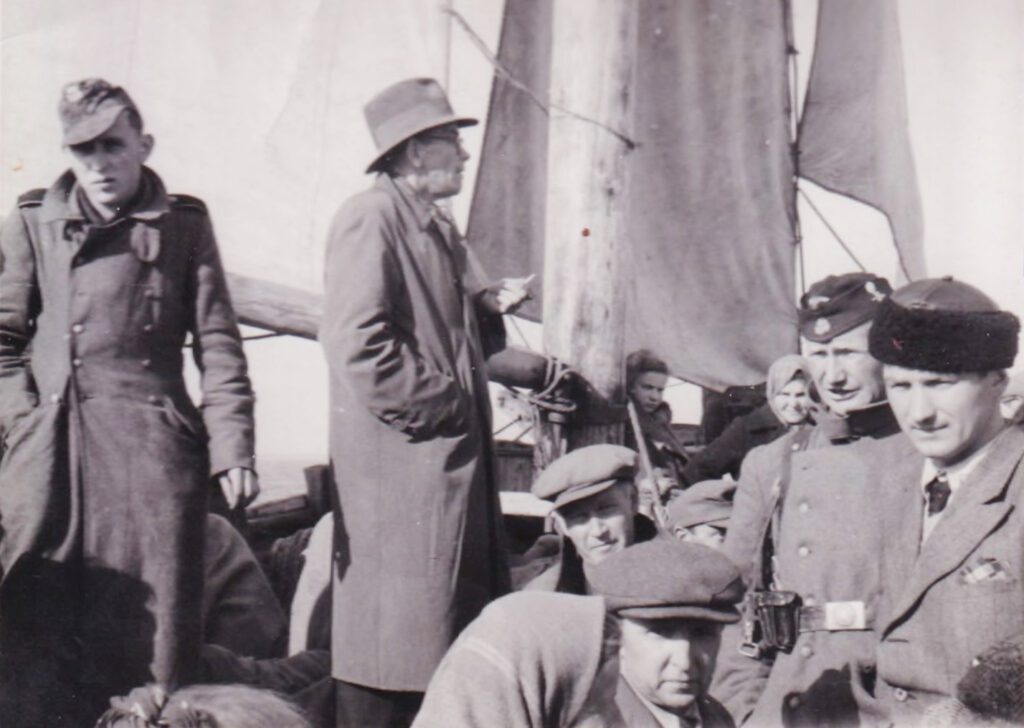
“Kristiine” is a small two-masted sailboat. My guess is that she was about 15 m long and had been used for fishing. She also had an engine but a defect prevented its use. Unfortunately we did not have a qualified mechanic in our group who would be able to rectify the problem.
Our group that originally was to board the “Kristiine” had now grown from 40 to over 120 persons. Many had joined in Paatsalu, Virtsu and Kuivastu. We were finally able to board at 1 AM on September 24. The boat was however, not allowed to leave in the dark and the plan was to leave Sunday morning where we were supposed to travel in the direction of Kuressaare on the Island of Saaremaa. A tugboat would be pulling us in the morning. A further hand-delivered letter ordered the ship to stay in port. At this point, the Captain offered some good advice that was sent back by the messenger. The “Kristiine” would get a head start because of favorable winds and the lack of an engine and make her own way in the suggested direction. As soon as the tug returned to the harbor, the “Kristiine” hoisted sails and began a voyage by sea.
(to be continued)