We sailed for some time directly towards the island but as we neared, we changed course to pass the northern tip of Saaremaa, and now the “Kristiine” headed directly towards the Swedish coast. Wind picked up and the situation improved with the increased speed.
This small sailboat became a racehorse and rushed headlong into the seas. People were seasick except for a few exceptions. I was one who was spared that fate. Everyone else in my family was sick. Small Ene-Mai repeatedly asked, “Mom, I do not want to swing any more”. My tiny boy vomited repeatedly and wanted nothing to eat. This mad dash into the waves continued all night long. While I probably could have managed otherwise, I was given a small crew cabin. There was a small table and three wooden berths. There was also a small iron stove, but it was not well fastened down and kept swinging back and forth. Lighting a fire would have been impossible. At least there was a place to put the small children.
Only briefly was I able to go topside. The picture I saw was frightening. The sea roared and the wind snapped the sails and whistled through the rigging. The waves sparkled and threw sparks each time we smashed through them. It was like a journey to the end of the earth.
On the second morning, we discovered that we had deviated from our course substantially. Meanwhile, the wind had abated, and we continued to drift further off course. Once more our journey became worrisome. Finally, land appeared, and we were happy that we had arrived somewhere. It was a small island. (Gotska Sandon is a Swedish National Park and a small island in the Baltic Sea.) A small boat with some men was sent ashore but it turned out that nowhere could they find any sign of human occupation.
Now was not a good time to set on our journey again. The sea had risen again and there was a strong headwind. We decided to stay overnight at anchor in the lea of the island. While at anchor, the ship rolled again and again in the swells, but it was still better that land was close by and we hoped the greatest danger was already behind us. In the early morning, our small ship was able to send up some distress flares. These had been seen from a lighthouse on the island, and a few hours later a small Swedish naval vessel came to our aid. It took us into tow, and this gave us some reassurance. This good and confident feeling was short-lived, and what followed far surpassed our past experiences by several-fold. The storm we entered was horrible. 10 balls. After leaving the lea of the Island the ship really began to dance. Our ship was hooked up to the tow cable from the anchor chain and now we had little control over our destiny. The small but powerful Swedish patrol boat rode up the huge waves and disappeared over the top. The tow cable pulled us through the huge waves only to repeat the process time and again. Our boat crackled and groaned. The anchor had broken loose and was constantly pounding the hull like a huge axe. I was sure that at any moment the hull would be breached and we would fill with water.

I was lying on top of a bunk in the small cabin keeping my right hand on top of my five-month old baby as the left hand grabbed hold of the ceiling. Ene-Mai was the bottom bunk and slept quietly. I believe that she was so exhausted that nothing would now disturb her. The boat was tossed around in the waves like a rubber ball. The fluctuation was so strong that my remaining possessions were flying around the cabin. The water came in from everywhere. Each time as the ship plunged straight into the waves a deluge of water poured in from above.
The water was already knee deep on the cabin floor. Rudi’s pants were rolled up above the knees and he did his best to keep our things from the water. The cabin had a small table, an iron stove and a small bench. Nothing could be left on the floor but because of the wild motion of the ship, it was virtually impossible to keep anything safe. The iron stove, kerosene cans, milk containers, all kinds of bags and packages were rushing from wall to wall to the accompaniment of a terrible roar and rumble. In the end, everything was soaking wet. The bottom bunk was partly submerged, and Ene-Mai had to be saved from lying entirely in the water. Only the upper bunk kept the baby boy out of the water. Evi sat on a small bench on the edge of the cabin with snow-white face. Her hands were holding on to the edge of the bunk. Nobody was able to speak.
The distance to our next destination was barely 20 nautical miles. In normal seas, this could be covered in a few hours. The journey now, however, went on hour by hour. We did not see land anywhere. The only and constant experience was the wild abandon and the constant rumble of the terrible mountains of water. All of us, and I believe that all on board had one thought – death. First and foremost, there was time for reflection and I thought about those that had meaning in my life. I thought of my mother and others close to me. I did not want to die but I was comforted by one thing. If we will die, we will all die together, and we will die in the free and clean sea and not in hands of the Bolsheviks. This would be a beautiful tomb for all of us.
Yes, we could speak of nothing serious at this time. I am sure that Evi and Rudi had their own thoughts and fears about what might happen, but we did not share these thoughts. In my helpless position, there was little I could do to affect the outcome. The best I could do was pray. Over and over again I asked only for “Our Father, who art in heaven,” I read this as a direct request to help find an end to the horrible situation we were in. I felt that at any moment the anchor will pierce the bow, now the vessel will fill with water and now death will come. This terror continued for 10 hours. This was 10 hours in the total fear of death and the end of a life, and many lives unfulfilled.

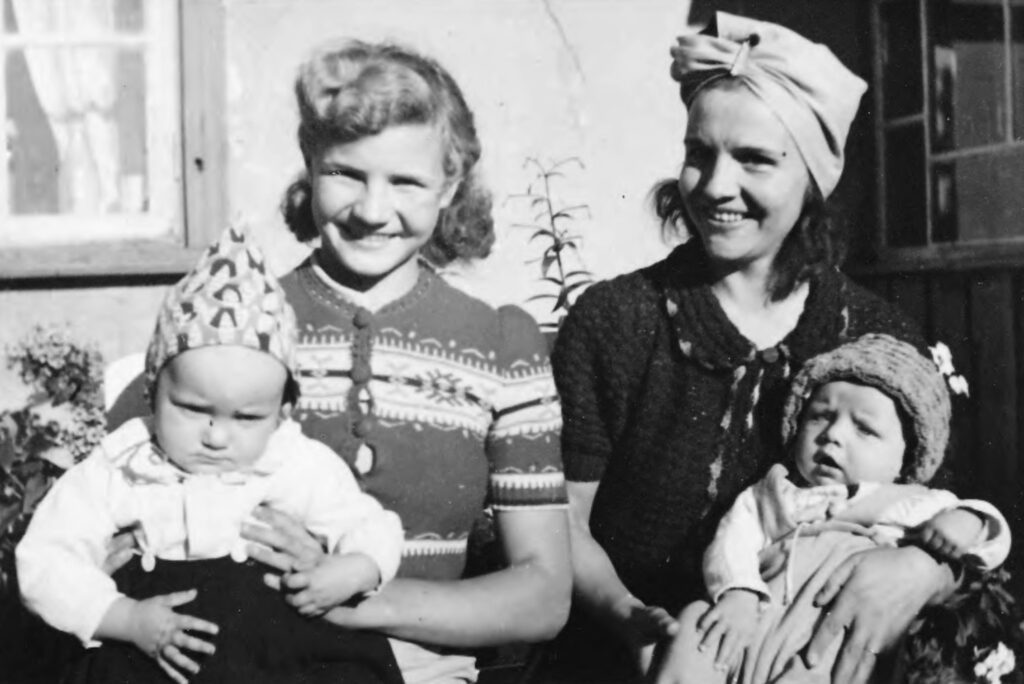
But our “Kristiine” survived. The sea swells became calmer as we entered the narrow passage and, in the distance, we could see the glorious harbor lights of Fårösund on the island of Visby. Finally lights after the horror and darkness of our stormy escape. It is difficult to express and even understand what this means. They were the lights of life to us. Soon we reached the port. The command was given for women and children to disembark. I took small Ene-Mai who was soaking wet and very cold. I had to undress her and found a more or less dry coat that had been hanging from the ceiling and wrapped it around her. Then along with Evi carrying the baby we left the ship and placed our feet on the Swedish soil. We stood on the shore with bright friendly lights all around. I only wanted to fall to the ground and kiss the soil. We had escaped from what has seemed like a certain death and we had a chance to begin our lives again.
Some additional facts.
– There was a total of 126 persons aboard the “Kristiine”. There were 10 children under the age of 13. The youngest of these was Tõnu at the age of 5 months. Among the passengers were lawyers, architects, army officers, soldiers, farmers, teachers a professor, and many others. There were no casualties on this journey although countless other Estonians fleeing from the Russian invasion perished during these stormy nights. The eventual fate of the ship “Kristine” is unknown.
– The senior officer on this ship was Eduard Kägi. Aside from being a licensed Merchant marine Captain he had been the director of the of the Estonian Merchant Marine School. He subsequently settled in Sweden and was ordained as a minister of the Estonian Lutheran Church. I met with Rev. Kägi in 1994 in Sweden where I had a chance to talk about this crossing with him. He still had good memories of this trip and had included a chapter in his memoirs. He was a good friend of our family and My Father had received many letters and cards from him in the following years. He died in 1997 at the age of 98.
– During our stay in Sweden the Orav family was able to stay together. We spent about 1 week on the Island of Visby near the port Fårösund. We then were transported by a regular ferry service from Visby to the port of Oskarhamn. From there we travelled by bus to the town of Högsby. Shortly after our arrival we were provided a more private place south of Högsby in an area called Sinnersnäs. Rudolf Orav was able to begin work in a furniture factory in the town of Ruda (Aktiebolaget Rudamöbler). This followed shortly after with employment at (Broderna Jonnson Snickerifabrik) in Norrköping where we moved to shortly thereafter. We spent the next few years in Norrköping and in November of 1947 we moved to a suburb of Stockholm called Gubbängen where he was employed by Skane-Alands Snickerier once more as a skilled cabinetmaker.
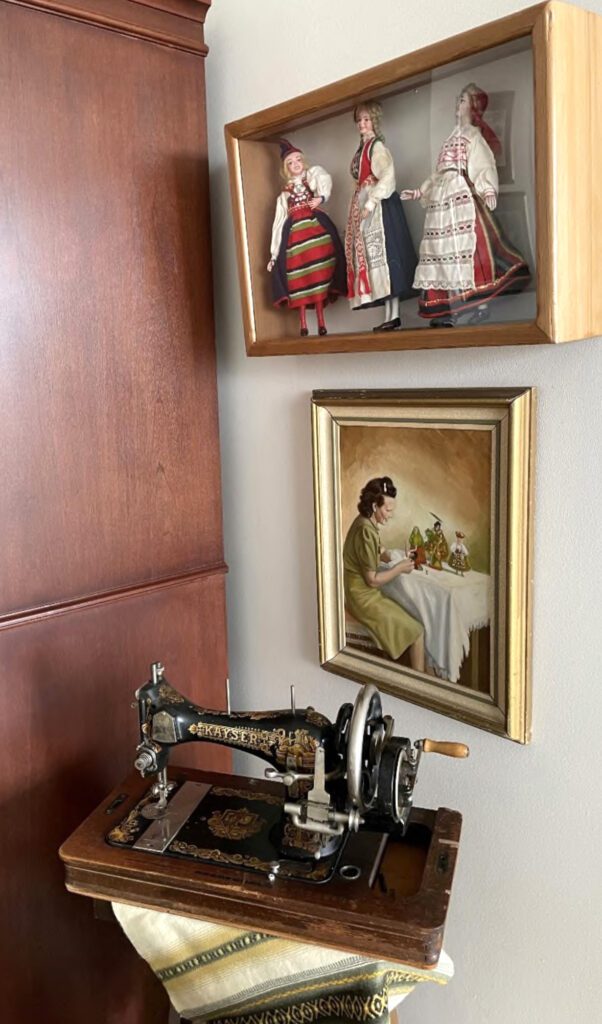
– During this period Alvi Orav my Mother was largely occupied with the task of bringing up two very small children. She did make use of another great skill that she had. She was a talented artist capable of doing wonderful things by using clay and paper. She was able to make dolls. There was a great demand for dolls in national costumes. She made hundreds, maybe thousands of these dressed in Swedish and Estonian costumes. This job was greatly assisted by the sewing machine that she was able to bring along from Estonia. These dolls were sold by one of the large department stores in Stockholm and provided much of the extra funds needed to emigrate to Canada.
– On April 1, 1949 we left Sweden from Göteborg (Gothenburg) on the Svenska American Line S.S. Gripsholm arriving at pier 21 in Halifax April 14, 1949.
Alvine Orav – Died in Toronto in 1979.
Ene-Mai Orav – Died in Toronto in 1982.
Rudolf Orav – Died in Toronto in 1989.
Evi Orav (now Byrne) – Died in Phoenix, Arizona, May 2015. Her son Michael and daughter Anna Liisa and their families continue to live in Arizona.
– Tõnu Orav married Elle Ruth Ellerhein in 1971. They have two children: Toomas born in 1974 and Heili born in 1978. Tõnu and Elle live in Thornhill, Ontario.