But life as a refugee did not end with unanswered questions. Those of us who escaped did not have to face executions or involuntary relocations, particularly the infamous major deportation of March, 1949. Fate had given us a virtual passport to eventual freedom. Freedom to move on. And by way of our recollections, we may now also move on and consider some rapidly unfolding developments during the early exile years.
While viewing the following partially as a sermon to the converted, I get excited at this time contemplating my own albeit restricted awareness during the Escape and in the refugee camps. Nevertheless, in spite of my early years at a critical time, there remains a personal memory of the numerous aspects of what I consider to be the legacy of the Great Escape.
Let's start with life abroad with no daily doses of lies and propaganda seeking to create a Soviet mindset. In the post-war world, first in Sweden, then immediately in refugee camps in German zones not occupied by the Soviet Union, there developed myriad little ,,Estonias”, many of them with an elementary school, choir, theatre, newsletter, scout and guide troupe – soon we would add folk dancing and eventually rhythmic gymnastics. That was the least the political refugees could build on as a replacement for their homeland. The need and desire for survival and continuing identity was both conscious and unconscious; even during the slowly stabilizing early years, the future was still uncertain.
During those times we did not have time to analyse our feelings. Survival does not allow for reflection. Aside from a few nightmarish memories, I, as a child of the Great Escape, lived in the present. There was no time to despair as things got from very bad to a little better and a lot better later on.
During the first decade, a practical legacy of the Escape was an incipient super-organized global community of Estonians with smaller units in many major and minor cities in Australia, Canada, England, Sweden and the US as communities in West Germany started withering. Soon there emerged a global infrastructure that the currently re-generated Estonian global community is benefitting from now, complete with new ambassadors and consulates. Let's keep in mind that almost all of Estonia's pre-war ambassadors stayed abroad and refused to return when recalled by the new Communist government in 1940.
A strong aspect of the legacy from the Escape of '44 was in the area of publication, in itself a reflection of the Republic between 1918 and 1940. Quite the opposite of the monstrous destruction of books carried out in Soviet-occupied Estonia during the 40's (and even the 50's) that has been well documented by researchers and writers in Eesti.
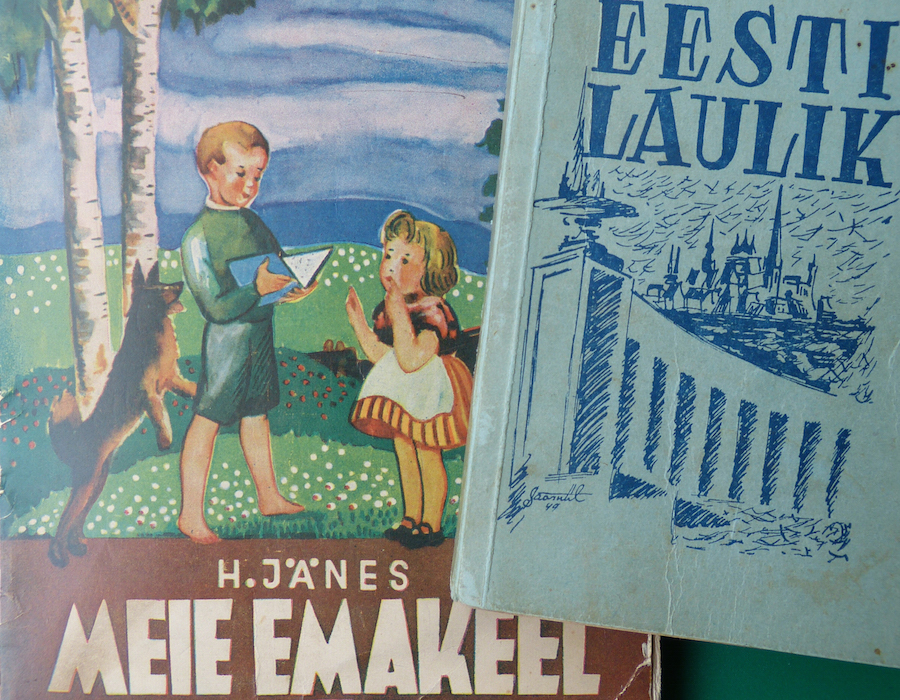
Ex-patriate publication began in Sweden. It included not only reprints of novels written in Estonia but new creative works that grew in numbers inadvertently trying to replace the volumes burned or otherwise destroyed in their homeland. Newly established Estonian newspapers printed in countries where the exiles had gathered soon reached Estonian homes all over the world – except Estonia. Printed in Sweden, my grammar book became a mainstay in my refugee camp school classes. A particular feature in refugee life was the publication of pocket-size songbooklets, often with a mixture of sacred hymns, patriotic songs and secular ditties. These enabled families and groups to maintain their spirits during an otherwise depressing time.
In the concluding second part of this article I will deal with the dominant and most dramatic aspect of the legacy along with some other signifiant features of the post-Escape period.
to be continued …
Andres Raudsepp