SCI is the oldest and one of the largest figure skating organizations in the world. Its mission is “to be a leader in the delivery of quality skating programs and continuously develop champions,” says Skate Canada.
SCI is the second competition in the annual International Skating Union’s (ISU) Grand Prix Tour, a tour that contains six stops and whose goal is to allow skaters to qualify for the ISU Grand Prix of Figure Skating Final. A competition that will go from December 10th to 13th in Chongqing, China.
The rules of the Grand Prix tour are as follows: each skater can go to no more than two qualifying events; the top three podium placements get fifteen, thirteen, and eleven points, and so on; and twelve total skaters (six men and six women) qualify for the final in Chongqing.
Doctors told her that it would be three years before she skated, but just one year after her diagnosis, she was back to competing… In 2025 she became the first Estonian to win the ISU Championship title when she won the ISU European Championship.
Competing in the tournament is on an invitational basis and only the top three athletes from the previous season have a say in where they compete. However, it is ultimately up to the ISU to decide which athletes compete in which competition.
The first stop of the Grand Prix Tour took place in Angers, France, for the Grand Prix de France. With one Estonian athlete, Aleksandr Selevko, competing. However, Selevko finished in fourth place in the men’s singles and just missed out on the podium.
For the second stop of the Grand Prix Tour in Kelowna, two Estonians were selected by the ISU to compete. Those two were Niina Petrõkina and Mihhail Selevko.
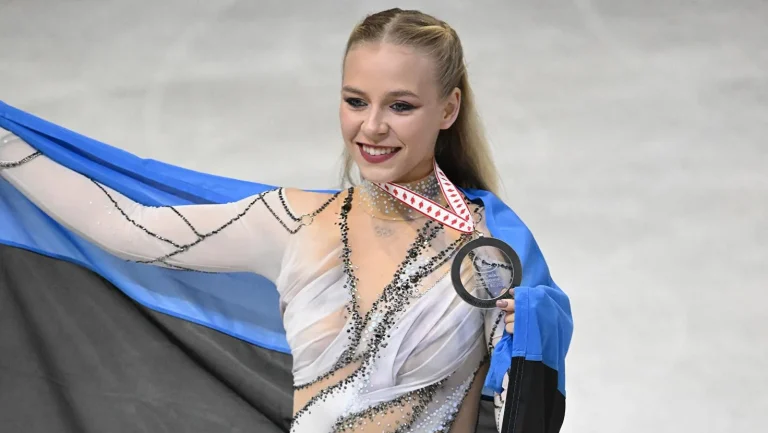
Tallinn-born Niina Petrõkina is widely considered the best and most accomplished Estonian figure skater in the world, and at only twenty-two years of age, she still has a long way to go.
But her path to stardom has been far from easy. At the age of fifteen, she was diagnosed with aplastic anemia, a rare and serious blood disorder, one that without treatment can be fatal. The condition left her in the hospital for five months and figure skating was out of the question.
Doctors told her that it would be three years before she skated, but just one year after her diagnosis, she was back to competing.
Her hard work and perseverance paid off. In 2025 she became the first Estonian to win the ISU Championship title when she won the ISU European Championship.
Last year she was not able to compete in the ISU Grand Prix as she suffered from health issues and needed Achilles tendon surgery, which meant she needed to withdraw from her scheduled Grand Prix assignments. But this year she looks to improve even more.
She told Pirouette Figure Skating Magazine, “My main goal for the biggest events of the season is clear—to qualify (for the top event) and to improve my (World) ranking,” and “Last season, due to my injury, I missed the first half of the season and my ranking dropped. Now I’m in 11th place but I’m aiming to be higher.”
Coming into the competition, Petrõkina is a two-time winner of the ISU European Championship (in 2025 and 2026). She is a four-time national champion (in 2022, 2023, 2025, and 2026), and she is an Olympian. Having placed 7th in the women’s singles event at the 2026 Milan-Cortina Winter Olympics.
The second Estonian at the event is Tallinn-born twenty-three-year-old Mihhail Selevko. He is the younger brother of Aleksandr Selevko, a four-time Estonian national champion and two-time Olympian.
“I went through a really tough time. I had some injuries, and I just couldn’t get myself together. Nothing was working in practice… So I realized I had to change something—or retire from figure skating.”
Mihhail Selevko
But Mihhail has had no issues making his own path. He is also a four-time Estonian National Champion, as he and his brother have won the last eight competitions between them. Mihhail and his brother are widely considered Estonia’s best men’s figure skaters.
Mihhail has also had his fair share of struggles; following injuries, he questioned his future in figure skating. He told Golden Skate, “I went through a really tough time. I had some injuries, and I just couldn’t get myself together. Nothing was working in practice,” he recalled. “So I realized I had to change something—or retire from figure skating.”
After thinking it over, this summer he decided to try something new, joining coach Svetlana Varavskaja, the same coach as Niina Petrõkina. This new setting has unleashed the best side of Mihhail, as he placed on the podium in the three events leading up to SCI and won two of them. Skate Canada International would prove to be the toughest test for both Estonians, as every skater is looking to qualify for the season-ending Grand Prix Final.
Selevko would compete first between the two. After his first skate, he placed fifth, but a strong second performance saw him jump all the way to third, as he nearly eclipsed his personal best set in September. This performance saw Mihail become the third Estonian to win a medal at an ISU Grand Prix event, joining his older brother Aleksandr Selevko and his training partner Niina Petrõkina.
“Today I needed and wanted to do better, so I focused on every jump. I’m very happy it worked,” Mihhail Selevko told ERR after his podium finish.
Niina Petrõkina would compete next, and after a strong first skate she found herself in third place. A convincing second performance would see her achieve a new personal best, move up a spot, and finish the competition in second place, making her the second Estonian to finish on the podium.
These two athletes have represented Estonia marvellously, both achieving podium scores and gaining eleven and thirteen qualification points, for Selevko and Petrõkina, respectively. As both are in the form of their lives, qualifying for the ISU Grand Prix Final is a real possibility.
The pair will compete for the Finlandia Trophy, their second and final ISU Grand Prix Tour stop. Taking place from November 20th to the 21st in Helsinki, Finland, the two hope to have their best performances yet and qualify for the prestigious ISU Grand Prix Final.
This article was written by Marc-André Perron as part of the Local Journalism Initiative.