written by Vincent Teetsov (together with Robert Teetsov)
Somehow or other, it had been seven years since the last time I was in Estonia. And in those seven years, since April 2018, a lot had happened and changed, both in my life and in the nation I was visiting.
In the never-ending summer light, I pulled my suitcase through the Viru Väravad, the gates of the Old Town. Onto the cobblestones. Past the flower vendors. In the window of the hostel room, one could see the spire of Oleviste Kirik glowing. History before your very eyes.
The visit had a couple of different purposes. I was there to visit friends and family. I was there to see all that I’ve been thinking about and writing about since I started at Eesti Elu in the spring of 2020. But very significantly, my Vanaisa, Ants Teetsov, had passed away less than a week before. Tallinn was the city where he had gone to school and lived with his brothers, sister, and parents, whenever they weren’t at their family farm in Penuja, southern Estonia. So it became a tribute to my Grandpa as well.
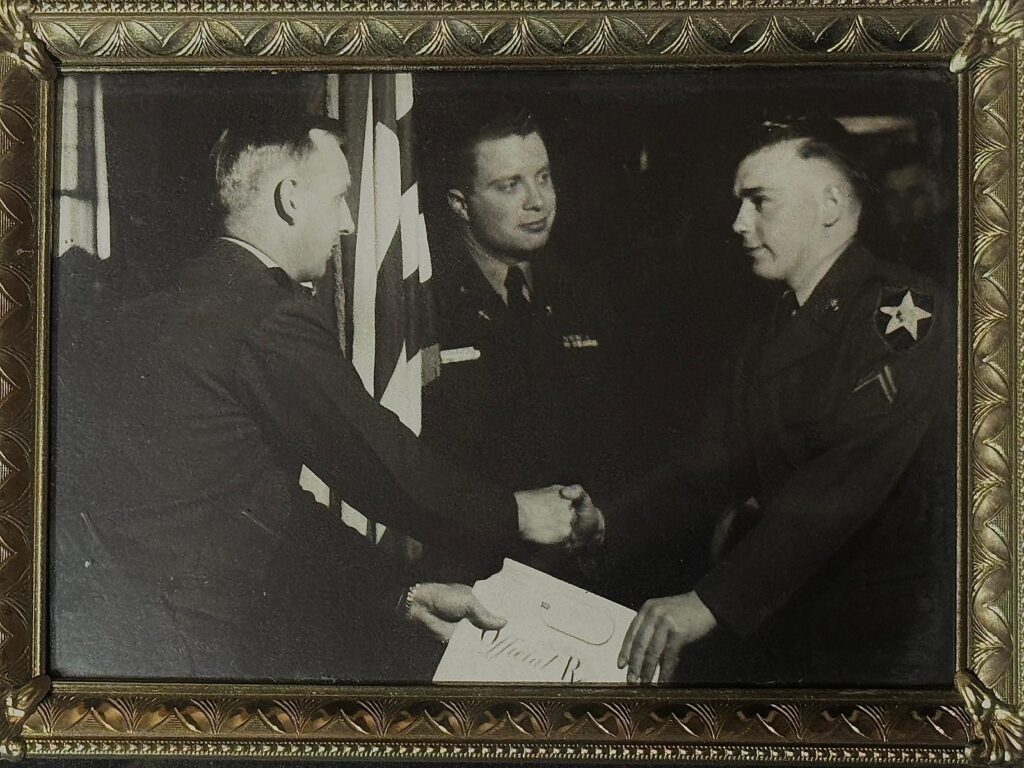
Ants Teetsov was born in Halliste, Mulgi Parish, Estonia on November 26th, 1931 to Jaak and Valentina Teetsov. Prior to Ants’s birth, Jaak Teetsov had fought in the Estonian War of Independence, and in his life worked as a police constable in Tallinn, living there with his wife, his son Ants, and Ants’s five siblings.
At the age of thirteen, Ants, his mother, and his three younger brothers, fled the incoming Soviet invasion on one of the last ships leaving Tallinn’s harbour, eventually making their way to the American occupation zone of Germany, where they lived in a DP camp in Aschaffenburg.
As my father and uncle recently recounted the history, in 1949, Ants’s family was sponsored by the Lutheran Resettlement Service and a farm family in Nebraska. Two years later, they moved to Crystal Lake, Illinois with a work opportunity at Terra Cotta Industries, which started by making terra cotta building products but involved the strenuous, dirty job of steel treating when Estonians worked there.
He became a United States Citizen, in uniform on the historic deck of the battleship USS Missouri on November 11th, 1954, the United States’ very first Veterans Day.
During the Korean Conflict, Ants served with honour as a US Army MP for the Headquarters of the 129th Infantry Regiment of the 2nd Infantry Division. He became a United States Citizen, in uniform on the historic deck of the battleship USS Missouri on November 11th, 1954, the United States’ very first Veterans Day.
In 1957, Ants married the love of his life, Leini Anto, who also had to flee the second Soviet invasion of Estonia—in November 1944—with her mother, aunt, and cousin. Ants and Leini would have celebrated their 68th wedding anniversary on June 22nd of this year. Ants was the proud father of four sons—Paul, Allan, John, and Robert. Ants was a loving father and did his best to teach his sons what he had learned from his boyhood days, and what he had learned from making his way as a new citizen of the United States. He encouraged his children and grandchildren to go to university and to make the most of their talents, to work hard in pursuit of what they cared about.
Ants always worked diligently to take care of his family and always put taking care of his family first. Ants and his youngest brother, Enn, worked together as union carpenters in TLT Homebuilders and Teetsov Brothers Construction. The legacy of Ants and Enn working together as master carpenters is the many homes that they built and renovated over the years. Ants and his brother even met Chester Gould, the cartoonist who created Dick Tracy, when they renovated his home.
It was clear to see, in his actions, his family, his words, his personality, and the way people speak of him, that Estonia was always in his heart, and indeed, part of his heart always remained in his homeland. He and his family kept in close communication with family members who remained in Estonia. They were even able to bring his sister Aino and her family to the US in the 70s. The first chance he could visit independent Estonia, he did so, photos of which were fondly shared with me at a reunion in Tallinn.
To the very end, even when it was difficult to use his voice, hear, or see, he savoured every opportunity to speak and hear his mother tongue, in books, songs, and conversations. I will always be grateful for the times my wife and I could have dinner with him and speak in Estonian, followed by a performance of “Metsavendade laul,” performed in as spirited a way as possible.
Losing my Grandpa has been painful. But as a man who was always with us, always there for us, I unequivocally felt his presence in visiting Tallinn.
He would be happy to see how brightly Estonia is shining as an independent nation. How they lead the way and continue to love their land and culture. Moreover, it was a pleasure to see how positively innovative Estonian society is. Just like my Grandfather, I find satisfaction in organization, work done properly and sincerely.
… the silence was broken by three students in uniform, who swung the front door open and marched in the direction of Kadriorg, where my Great-Grandfather Jaak worked. It felt like a symbolic reunion, of my Grandfather heading back to his father.
In one reflective moment, while visiting Ants’s former school, silence was broken by three students in uniform, who swung the front door open and marched in the direction of Kadriorg, where my Great-Grandfather Jaak worked. It felt like a symbolic reunion, of my Grandfather heading back to his father.
The whole time, I felt I was walking in his footsteps and the footsteps of my family both here and no longer on this plane of existence. So each footstep was followed, with a hunger to feel my grandpa’s homeland as he had. I walked my shoes and feet into oblivion. I ate every Estonian dish I could find. I played music just as he always encouraged, to be a “tubli muusikamees.” I met with dear friends and family and got to know cousins I hadn’t met before. I felt the growing power of the summer sun leading up to Jaanipäev.
But as much as the word “I” has been used here, it felt like us. And that won't ever end.
Reflecting on his ninety-three years, as much as there was tragedy, loss, and upheaval, there was joy, victory, and the strengthening of roots. He saw the very worst and the very best. It’s a miraculous life passage that truly represents the ups and downs that make our existences what they are.