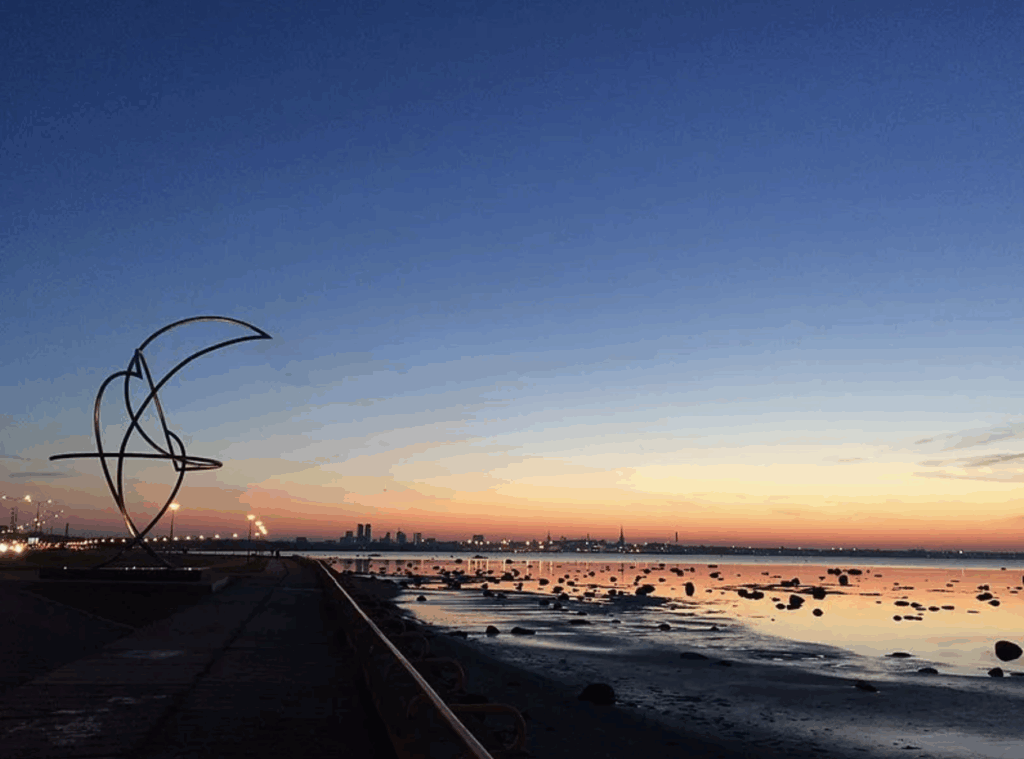
It’s also called the Charles Leroux Monument, which connects to its French inscription: “À LA MEMOIRE DE L’AERONAUTE CHARLES LEROUX, QUI PÉRIT DANS LA BAIE DE TALLINN LE 12 SEPTEMBER 1889.” In memory of the balloonist Charles Leroux, who perished in Tallinn Bay on September 12th, 1889. His name is seldom mentioned today, but 136 years ago, Leroux was a celebrated daredevil, both for his ascents by balloon and his descents by parachute. What happened in Tallinn, and what else can we find out about him?
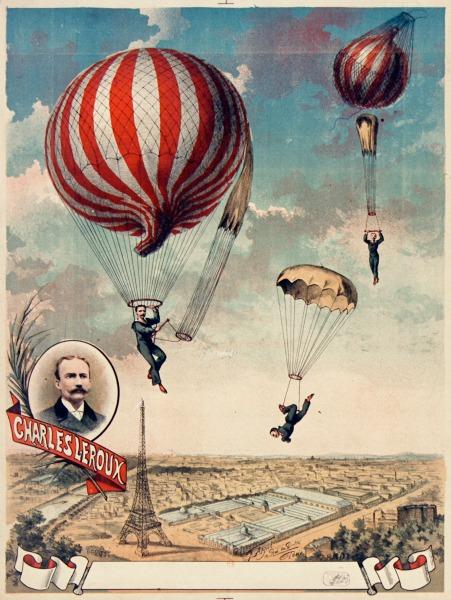
Despite the name and inscription, he was not French. Born Joseph Johnson in Waterbury, Connecticut in 1856, he performed as a gymnast and trapeze artist, jumping off bridges and buildings up and down the east coast of the US. As Mental Floss recounts, he adopted the stage name “Charles Leroux” in an era when the French were dominating balloon aviation. By 1889, he was touring to perform for audiences across Europe, from England to Austria, Germany, Russia, Ukraine, and Poland, with spectators keen for the grand stunts that blended physics and nerves of steel. Everything was going well until he came to Estonia. After two attempts, the Tartu jump never happened, due to issues with the gas needed to get the balloon floating. An event in Tallinn was due to close the tour, which would be his 239th jump.
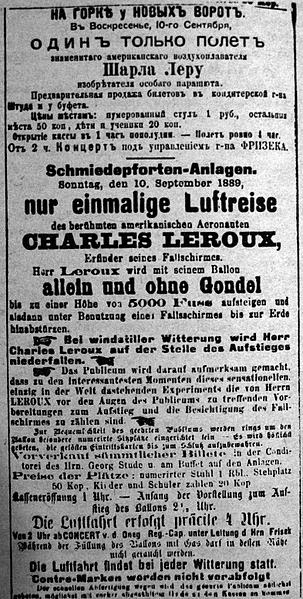
The jump was originally scheduled for September 10th, but was postponed to the 12th because of foul weather. The delay increased public anticipation, and the frustration of Leroux, who was having disagreements with his manager. Being the finale of his European tour, and already having had issues in Tartu, it’s understandable that he would feel pressure to go ahead despite the conditions.
According to secondary source research by translator and editor Maaris Aas, it took two and a half minutes for the balloon to rise. Initially, when Leroux jumped, his descent was slower. But then “the wind started to tear the parachute and shake it badly, and the man hit the water’s surface” about a kilometre from the shore. It should be considered how rudimentary the technology would have been. Parachutes then were made of linen, canvas, or silk and probably packed by hand into the basket of the balloon. Certainly not the parachute deployment bags of today. And even as a purportedly strong swimmer, it’s suspected that the impact knocked Leroux out, resulting in his drowning. Minutes after impact, rescue boats found no trace of Leroux at the crash site.
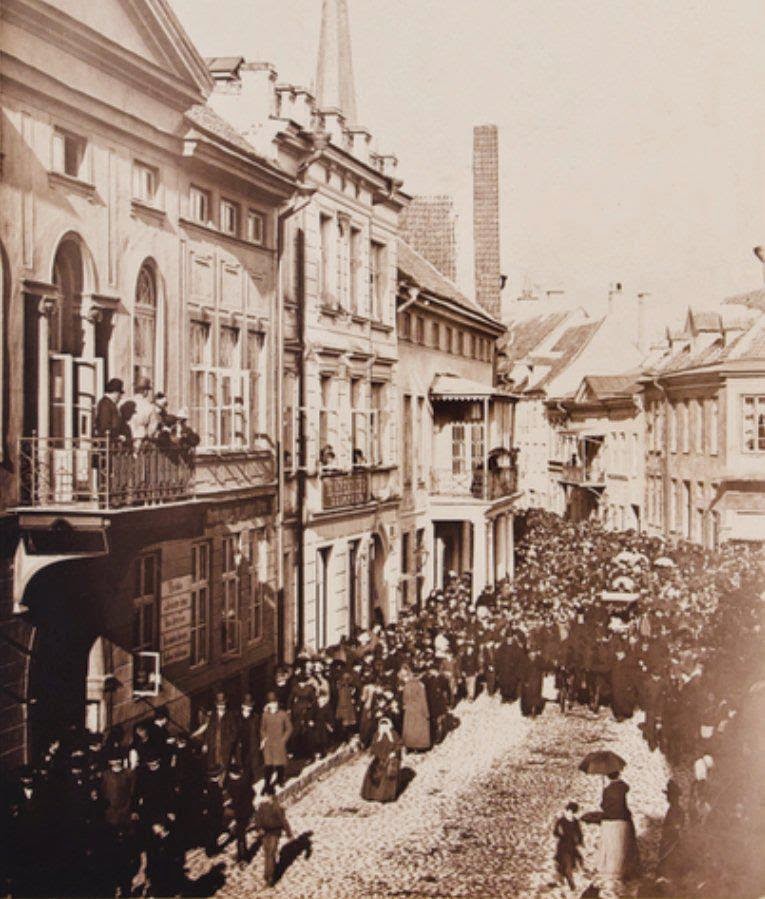
The accident initiated a forensic and technological investigation and public debate about accounts of the day and what exactly happened to him. On September 21st, his funeral ceremony was held, with a huge crowd of mourners forming in Tallinn prior to his burial in Kopli Cemetery, mostly concluding the tragedy and his story. As Dr. Alan P Newman writes in Atlas Obscura, “Until 1950, Leroux had an impressive stone memorial in the cemetery, but after World War II, the Soviets flattened the cemetery removing all traces of the grave markers. The site was later converted into a public park.”
But in 1989, one hundred years after Leroux’s Tallinn jump, the monument mentioned at the beginning was unveiled, created by sculptor Mati Karmin and delivered by helicopter pilots returning from the war in Afghanistan. Quite fitting for stunts that happen so quickly and precariously, the curved steel tubing offers us only a loose, abstract gesture, not a static figure.
Piret Tali of Eesti Päevaleht wrote in 2005 that beyond Leroux, the monument was “indirectly dedicated to the glider pilot Ville Ilus, who recently crashed in Viljandi County with his Cobra SP-W602, because the memorial is intended for all brave and determined people and for the entire aviation industry… In 1989, the installation of the sculpture was supported by the glider pilots, parachutists and aviation associations.”
The story continues to inspire curiosity. In 1989, Isidor Goldman and Ants Künnapuu published the historical overview Charles Leroux’ viimne hüpe (Charles Leroux’s Last Leap). In 2014, photographer Julia Borissova re-imagined Leroux’s story and “the concept of falling” in her photo/collage/origami-styled book Let Me Fall Again.
Depending on where and when you grew up, you might recall David Copperfield’s televised escape from Alcatraz Island in 1987 or Robbie Knievel’s 1999 motorcycle jump over the Grand Canyon. Or maybe you watched Criss Angel’s Mindfreak TV show. But today, this kind of collective, thrilling spectacle is a rarer thing.