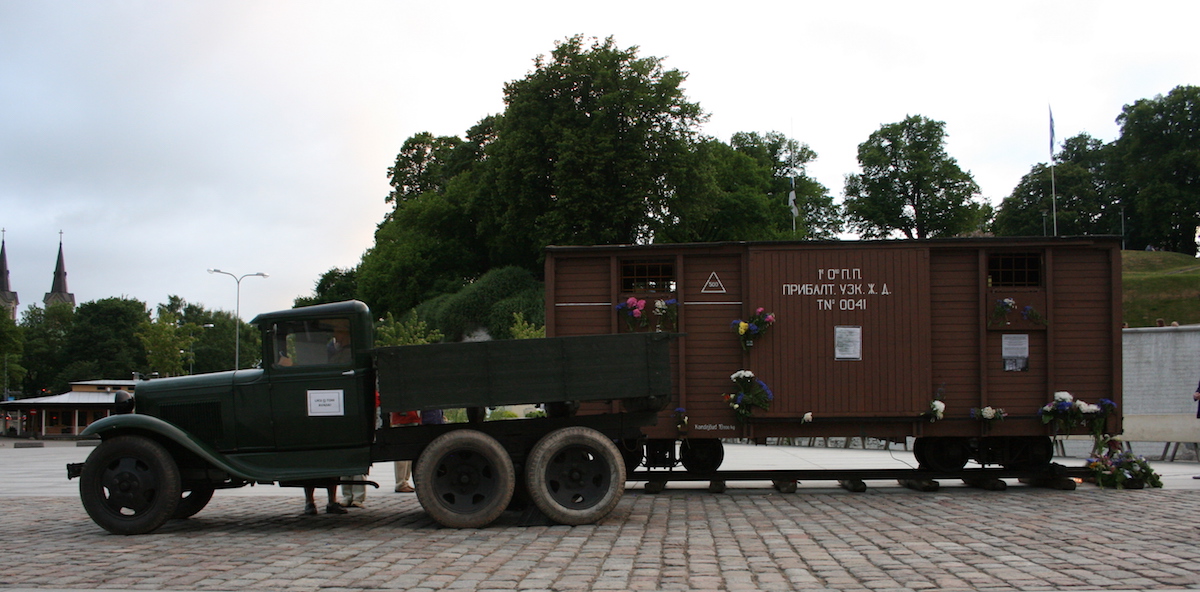
(One might note here that it would be very non-Estonian to burn the effigy of Josep Stalin. Rather it's more ethno-culturally typical for Estonians to do the dignified, reserved thing – to light candles in memory of those that suffered. Even in public displays involving serious protests, Estonians ren't raucous, unruly as demonstrations. They prefer torch-light parades or town hall-like meetings to present disatisfaction with a policy. The participants in the only street riot in recent history were non-Estonians, led by Moscow proxies, protesting the relocation of a Soviet monument to a military cemetery im 2007.)
Narva, a city where less than 7% of the local population is ethnic Estonian participated for the first time in the tribute to victims of the deportations. The commemoration was organized by the Russian speaking youth group “Open Republic” who also organized a related conference with the theme: “How do we proceed so that history unites, not separates us?”
It was totally expected that politician Yana Toom, a member of the European Union Parliament from Estonia and self-declared candidate for the position of the Centre Party's chair, would react in her typical manner: “We do not have to constantly bring up old issues and think of what happened in 1944 (sic. Ed.). What happened, happened. Let's move on.”
Toom has been long known to assume a pro-Moscow stance on issues such as the acceptance of Russia's annexation of Crimea, the ending of sanctions against Russia for its millitary incursion into Ukraine, defending Moscow's accusations about anti-Russian discrimination in Estonia, etc. Curiously, it's been said that when asked about her preference in living under prevailing political and econcomic conditions or the current situation in Estonia, she opts for Estonia's standards. This is not unusual for most of those who favour the Kremlin's politics but shudder at the possibility of actually being affected by them.
In direct contradiction to Toom's position, the youth of “Open Republic” state: “Isn't an open and fair approach to the issue (of deportations) the easiest way to community agreement? Or is the denial of unpleasant facts more dangerous? How do we handle sensitive issues in a way that it promotes public dialogue and doesn't polarize sides?”
It's well known that Moscow rejects the human tragedy of the deportation actions that lasted from 1941 into the 1950's. It dismisses them as ecocomically and politically necessary. By extension and the same arrogant logic, is the harassment and blatant bullying of Estonia and other neighbouring countries also a political necessity. Let the youth of Estonia, of different ethnic backgrounds generate public discussion of it as well.
Laas Leivat, Toronto