Subscribe Menu

The Engineer and the Totem Pole

In the summer of 2002, a special monument arrived at the grounds of Vienna’s Tiergarten Schönbrunn, the world’s oldest zoo, to mark its 250th anniversary. It was a fifteen-metre, 2.5-ton totem pole made of red cedar, carved by Alver Tait, a hereditary chief of the Nisga'a Nation’s Eagle-Beaver clan. The totem pole, symbolizing the unity of the Nisga’a peoples, was intended to stand outside the zoo’s newly constructed rainforest pavilion.

Yet, as the raising ceremony approached, it was unclear how to safely secure this work of Indigenous art upon arrival in Vienna.

The solution came from Karl Maru, an Estonian-Canadian tool design consultant—also active as a transport driver, hospital worker, businessman, entrepreneur, photographer, and delicatessen owner throughout his career—living in North Vancouver. Karl’s connection to the project was through his wife, Trudy Duller, who worked at the Austrian Consulate General in Vancouver and had been assisting with the diplomatic coordination. Confronted with the engineering impasse and equipped with a pencil, drafting paper, and a lifetime of mechanical intuition, Karl sketched a custom steel mount. Completed in less than four hours, according to project manager Peter Baird O.B.C., the design “[supplied] minute details of the mount required… the first of many dramatic examples of the abilities and capacities that Karl would bring to the project from that day forward.”
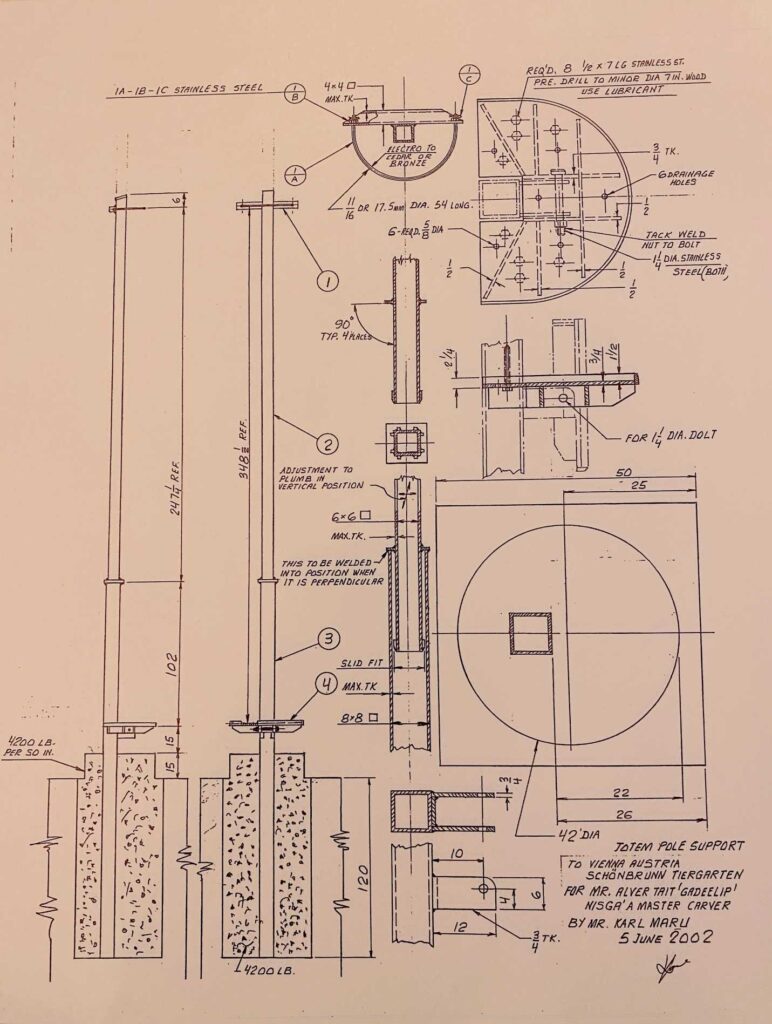
Karl's blueprints for the totem pole mount

How did Maru get to this point, though? Born in Abja, Estonia, in 1937, his early childhood was shattered by the Second World War. In 1944, Maru’s father was arrested and sent to a Siberian forced labour camp. Seven-year-old Karl, his mother, and his brothers fled their homeland aboard the ship Moero. Karl spent the post-war years in a displaced persons camp in Geislingen, Germany.

Karl in the arms of his mother, Marie Maru. Back: Mart Maru, Karl's Father, Karl Paldrok, family relative. Brother Peter, Alfred, and Martin Maru. Photo taken in 1937 at Maru Talu, Estonia

From there, the family settled in Canada with help from the Salvation Army, first settling in Kirkland Lake, Ontario, and then Toronto. Maru integrated into the post-war Estonian-Canadian community, including time singing in the local choir conducted by Eerik Purje. Eventually, Karl moved to British Columbia, which is where he and his wife Trudy opened (with a loan from the Estonian Credit Union in Toronto) and operated the Family Gourmet Delicatessen in North Vancouver for more than two decades.

In July 2002, Maru’s active involvement in the totem pole project continued in Austria with its final installation. On the zoo grounds, amid the stifling heat, Maru and master carver Alver Tait worked and communicated closely together. A deep friendship, trust, and respect formed between them. Tait moved ahead with the final carving phase on-site, with the media and crowds of onlookers watching with excitement as Tait worked on the eagle figure that crowned the pole. Maru helped apply coats of protective sealant and located a machine shop where the specialized carving tools could be sharpened.

On July 30th, 2002, the totem pole was raised, with members of the Austrian army and Viennese police and fire departments lending a hand. A Breath of Life dance was performed before millions of television viewers across Europe. This reverent, cross-cultural ceremony was led by President of the Nisga’a Nation, Dr. Joseph Gosnell. As Tait said in a handwritten note, “It is the tradition of the Nisga’a to breathe the breath of life into the totem pole before raising it. When the tree was cut down, the carver promised the Creator that he would not waste the tree or misuse it, but create a beautiful monument. When we carved the crests of our ancestors onto the log, we brought back our ancestors. Therefore, it is only proper to breathe life into it. Similar to a mother giving birth to a child. The carver brings life into the totem pole of our ancestors. After this, the totem pole is considered alive.”

Before the crowds gathered, however, Alver Tait offered a private recognition of his valuable engineering support and their shared labour, inviting Karl to carve his own name directly into the cedar, where the eagle is mounted, a permanent signature of their partnership.

While Karl Maru passed away recently, this extraordinary story, outlined in a binder of photographs compiled by his wife Trudy, remains for us to marvel at, along with the totem pole that stands to this day.

Read more