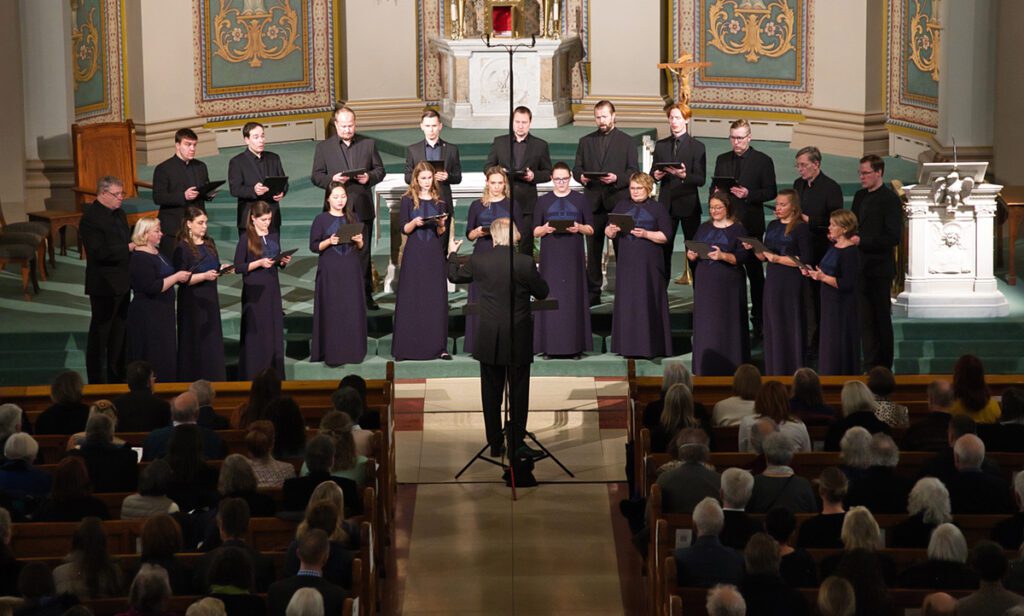
Although the music spanned nearly a half-millennium of choral history, the sold-out audience in St. Paul’s Basilica appreciated the deep connection between the music of Palestrina, Pärt, and the new work by Estonian-Canadian composer Omar Daniel.
In developing his tintinnabuli technique Arvo Pärt carefully studied counterpoint, the art of superposing multiple independent melodies to create a harmony. This technique, nearly perfected in the 18th century by J.S. Bach and extended to more chromatic harmony by later composers, has its roots in the Renaissance music, of which Giovanni Pierluigi da Palestrina’s sacred choral works are exemplary. As such, programming Palestrina with Pärt is the sort of master-and-student pairing one sees on programs of Schoenberg and Webern or Beethoven and Brahms.
The musical technique of Palestrina’s time stands out from later music in two particular ways: the very rigorous treatment of dissonance; and the use of modal scales functioning somewhat differently than our familiar “major” and “minor”. The former deals with how the independent voices move relative to each other, like the Earth and Moon circling each other, while the latter concerns the absolute motion of the notes, as the Earth-Moon system itself orbits the Sun.