It was at this store that I was first given a copy of Jaan Kross’ The Czar’s Madman (Keisri hull). At that age, I didn’t see much connection between the history of czars and the nation of Estonia. Still, that title and the mysterious art of the cover—someone in a field gazing at a statue by a fallen chair with a tall church spire in the distance—felt like a cerebral portal into a specific niche of the Estonian story. Years later, I found a statue of Kross himself near the store, holding a book. I took it as a sign to revisit the aforementioned story.
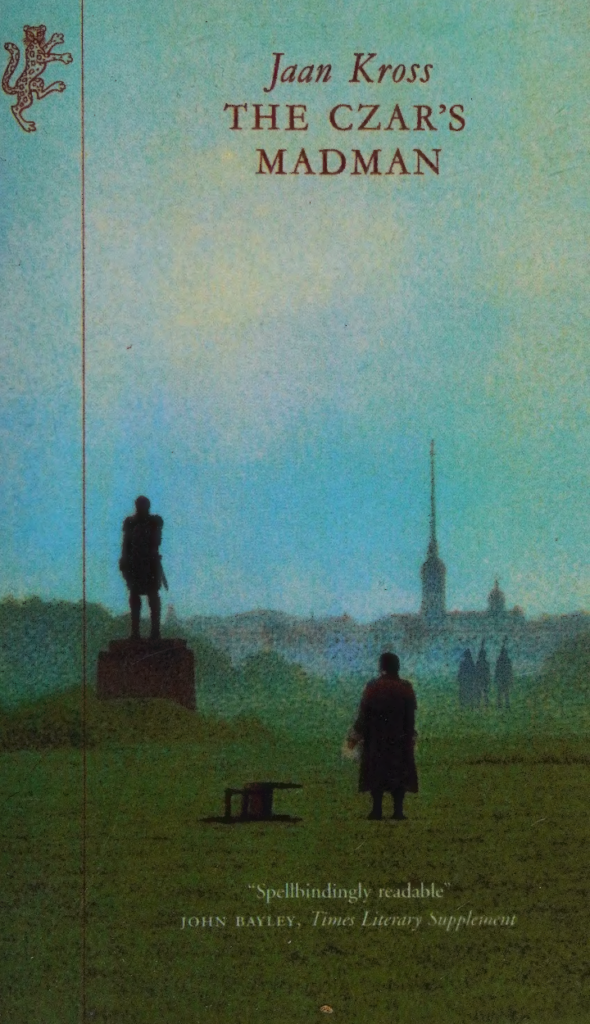
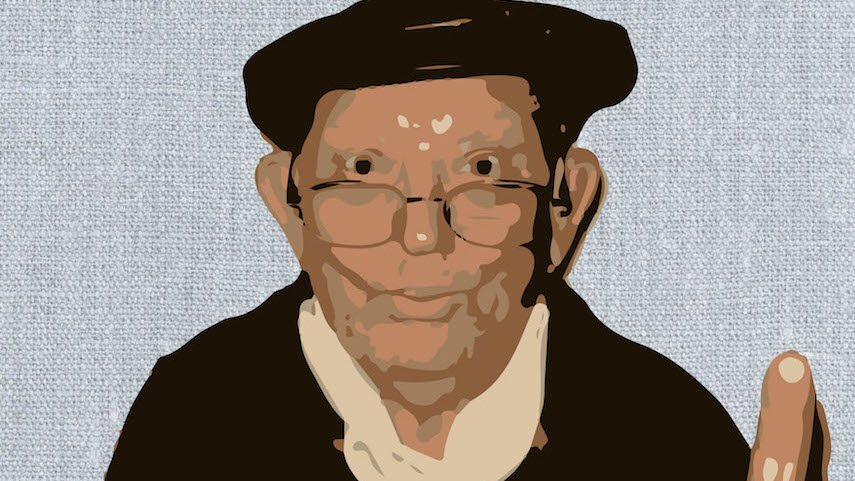
The narrative concerns Timotheus von Bock, a nobleman who makes a grave error. Having been invited by Czar Alexander I to provide an honest appraisal of the empire’s failings, von Bock submits a critique that verges on being a radical indictment. In response, the Czar effectively erases von Bock (you can see the historical parallels with the author’s era in late ‘70s Estonia) by declaring him a “madman.” Madness is a convenient label here. It allows the state to dismiss the critique and send von Bock away. This dynamic illustrates the terrifyingly arbitrary nature of ruin. Von Bock was a hero of the Napoleonic Wars, a man of great social standing and personal wealth. Nonetheless, Kross demonstrates that his status isn’t as fixed as it seems. “What does this all have to do with Estonia, though?” you might wonder. Well, Kross filters this history through the diary of Jakob Mättik, the brother of von Bock’s wife, Eeva. Eeva, born a serf, was purchased and liberated by von Bock so he could marry her. In a way, as much as we can see genuine love, it appears like a social experiment, to show that an Estonian peasant (and maybe even her brother) could be educated into a person of high culture. All of this was an affront to the Baltic German nobility, who viewed the division between the powerful Baltic Germans and the “undeutsch” Estonian peasantry as a divine or biological necessity. Jakob’s perspective is very intriguing because he represents the emergence of Estonian intellectuals. These happen to be Estonians with the literacy skills to document a transformation, the identity of Estonians, and the ruin of their masters, as precarious as the whole transformation is.