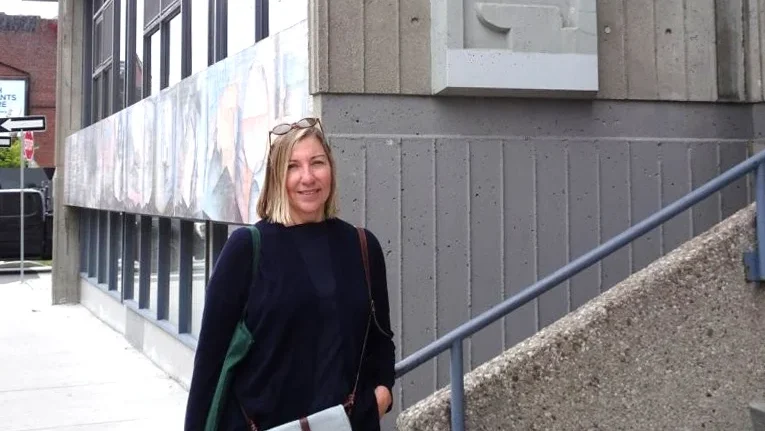
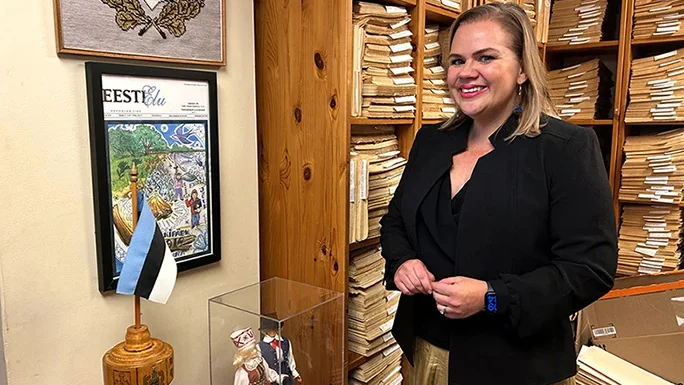
In a video interview from January 2026, Estonian-Canadian psychotherapist Piret Koppel stated, “People need to be heard. They need to be understood. And so do we.” Professional maturity and resolving human conflict rely less on trying to fix other people's lives and more on listening with compassion. It's conversations like these that show the wealth of knowledge and wisdom among Estonian communities, which is now more accessible through the support of the Tartu College Student Residence Scholarship (TCSRS).
The TCSRS—made possible by the Academy for Lifelong Learning and Tartu College Student Residence—supports academic and creative excellence within the resident community. As the Academy for Lifelong Learning and Tartu College Student Residence state, “TCSRS is awarded to full-term residents of Tartu College Student Residence engaged in impactful work. Tartu College Student Residence encourages recipients to utilize their work to contribute to the Tartu College community through events, activities, or projects.”
For Monika Siim-Kiviloo, a Tartu College resident, an Engineering Science student at U of T, and a part-time VEMU Estonian Museum Canada archivist, this contribution involved documenting the professional stories of Estonian-Canadian women. Below, Siim-Kiviloo shares how the series, titled “Likeminded: Estonian-Canadian Professional Women,” began and what was involved in creating it.
Vincent Teetsov: What were your thoughts about the scholarship, and what did you know about it before you applied?
Monika Siim-Kiviloo: I have known about this scholarship since last year. For the past two years, I have been living at Tartu College, and I first received this scholarship in 2025. Now, in 2026, I received the scholarship again to continue the series I started last year. I found out about it through promotional posters shown on the Tartu College TVs. Before applying, I did not know much about the scholarship other than that it was meant for Tartu College residents.
“…[We discussed] that there were not enough stories of professional women in the archives, and that many of the existing stories had been from men. This is how the special focus of the “Likeminded” interview series was born.”
VT: Did you have a clear idea of how you wanted to apply?
MS-K: When I am in Estonia, I work as a podcast host at TerviseTasku [an Estonian digital health platform]. I know that I enjoy hearing people’s stories. I thought this project would be especially interesting because I didn’t know many of the stories of Estonian-Canadians here. This is why I decided to create an interview series.
I had also previously discussed with Piret Noorhani [Chief Archivist of VEMU Estonian Museum Canada] that there were not enough stories of professional women in the archives, and that many of the existing stories had been from men. This is how the special focus of the “Likeminded” interview series was born.
VT: Can you tell us more about who you interviewed? What led you to choosing these interview subjects?
MS-K: My first guest for “Likeminded” was investor and educator Marielle Voksepp, who welcomed me into her home. We talked about how she found her way into her career after originally graduating from university with a degree in Physical and Biological Anthropology, about her work teaching entrepreneurship to youth, and the lessons she has learned along the way.
I have since continued these conversations with many professional women with Estonian roots, including Dr. Tiiu Põldma, Kia Puhm, Piret Koppel, Anne Remmel, Elva Palo, Mari Sild, and Pia Loorits. Choosing the guests for season one relied largely on recommendations I received from other people about who to interview, since last year was my first year in Canada and my circle of people was not very large yet.
VT: Before studying engineering, your studies had a media focus. In fact, you continue to film videos for Eesti Elu / Estonian Life. What was it like for you to create this series from a technical perspective?
MS-K: I think filming season one was actually quite a challenge for me because, most of the time, I was recording alone. I had to set up the camera, then go in front of it without really being able to see what was happening, and hope for the best. For season two, I definitely want to get some help and stay behind the camera myself so I can see if everything is looking good. From a technical perspective, I used Sony cameras owned by VEMU and bought small lavalier microphones that clip onto people’s clothing.
VT: Where can we watch the series?
MS-K: All of the episodes are and will be posted to VEMU’s YouTube channel. All of the interviews will also be added to the VEMU archives.
VT: How will this project continue from here?
MS-K: We will start filming season two of “Likeminded” this summer, which will consist of five episodes. So, if you know of any interesting professional stories of Estonian-Canadians that should be captured, be sure to email me at mmonikasiim@gmail.com .